

Clean Week
The Feast of the Annunciation
Fasting is not dieting. Fasting is not about keeping a Christian kosher. Fasting is about hunger and humility (which is increased as we allow ourselves to become weak). Fasting is about allowing our heart to break.
-Fr Stephen Freeman
Monday, March 18th
Readers Compline Canon of St Andrew: 6pm
Tuesday, March 19th
Readers Compline Canon of St Andrew: 6pm
Wednesday, March 20th
Confessions: 4:30-5:30pm
First Presanctified Liturgy of the Season: 6pm
Thursday, March 21st
Readers Compline Canon of St Andrew: 6pm
Saturday, March 23rd
Confessions followed by Great Vespers: 5pm
Sunday, March 24th: Sunday of Orthodoxy
Matins: 9:00am
Divine Liturgy and Icon Procession: 10am followed by Coffee Hour
GREAT VESPERS for the FEAST OF ANNUNCIATION (St Tikhon): 6pm
Monday, March 25th: The Annunciation to the Theotokos
Orthros: 8:45am (Annunciation Greek Orthodox Church)
Divine Liturgy: 8am (Annunciation Greek Orthodox Church)
CLEAN WEEK IN THE ORTHODOX CHURCH
Clean Week is the first week of the Orthodox Christian Great Lent.
The common term for this week refers to the leaving behind of sinful attitudes and non-fasting foods.
Liturgically, Clean Monday—and thus Great Lent itself—begins on the preceding (Sunday) night, at a special service called Forgiveness Vespers, which culminates with the Ceremony of Mutual Forgiveness, at which all present will bow down before one another and ask forgiveness. In this way, the faithful begin Great Lent with a clean conscience, with forgiveness, and with renewed Christian love.
The theme of the Canon is set by the Old Testament reading appointed to be read at the Sixth Hour on this Clean Monday (Isaiah 1:1-20), which says in part:
Wash yourselves and ye shall be clean; put away the wicked ways from your souls before Mine eyes; cease to do evil; learn to do well. Seek judgment, relieve the oppressed, consider the fatherless, and plead for the widow. Come then, and let us reason together, saith the Lord: Though your sins be as scarlet, I will make them white as snow; and though they be red like crimson, I will make them white as wool (v. 16-18).
CANON OF ST ANDREW
The Canon of St. Andrew of Crete is a very lengthy, penitential prayer that is broken up into usually four nights of communal prayer during Clean Week. We will gather together Monday, Tuesday, and Thursday to pray a portion of the prayer.
“If, in our days so many find it [the Great Canon] boring and not relevant to our lives, it is because their faith is not taking nourishment from the fount of Sacred Scripture, the spring which for the Fathers of the Church was the very source of their faith. We must once again learn to apprehend the world as it is revealed to us in the Bible, learn to live in that biblical world. There is no better way of learning this than through the church service, which not only passes on to us biblical teaching, but also reveals to us the biblical way of life.” (Fr. Alexander Schmemann, Great Lent, p. 97).
The Great Canon of St. Andrew, Bishop of Crete, is the longest canon in all of our services, and is associated with Great Lent, since the only times it is appointed to be read in church are the first four nights of Great Lent (Clean Monday through Clean Thursday when it is serialized) and at Matins for Thursday of the fifth week of Great Lent, when it is read in its entirety along with the life of St. Mary of Egypt.
There is no other sacred hymn which compares with this monumental work, which St Andrew wrote for his personal meditations. Nothing else has its extensive typology and mystical explanations of the scripture, from both the Old and New Testaments. One can almost consider this hymn to be a “survey of the Old and New Testament”. Its other distinguishing features are a spirit of mournful humility, hope in God, and complex and beautiful Trinitarian Doxologies and hymns to the Theotokos in each Ode.
The canon is a dialog between St. Andrew and his soul. The ongoing theme is an urgent exhortation to change one’s life. St Andrew always mentions his own sinfulness placed in juxtaposition to God’s mercy, and uses literally hundreds of references to good and bad examples from the OT and NT to “convince himself” to repent.
A canon is an ancient liturgical hymn, with a very strict format. It consists of a variable number of parts, each called an “ode”. Most common canons have eight Odes, numbered from one to nine, with Ode 2 being omitted. The most penitential canons have all nine odes. Some canons have only three Odes, such as many of the canons in the “Triodion” (which means “Three Odes”).
In any case, all Odes have the same basic format. An “Irmos” begins each Ode. This is generally sung, and each Irmos has a reference to one of the nine biblical canticles, which are selections from the Old and New Testament, which can be found in an appendix in any complete liturgical Psalter (book of Psalms, arranged for reading in the services). A variable number of “troparia” follow, which are short hymns about the subject of the canon. These are usually chanted, and not sung. After each troparion a “refrain” is chanted. At the end of each Ode, another hymn, called the “Katavasia”, either the Irmos previously sung, or one like it is sung.
The troparia of the Great Canon in all its Odes are usually chanted by the priest in the center of the church, with the choir singing the Irmos and Katavasia. There are varying traditions about bows and prostrations. Some prostrate and some make the sign of the cross and bow three times after the Irmos and each troparion.
GENERAL THEMES OF THE GREAT CANON
How we should think about ourselves
Where shall I begin to lament the deeds of my wretched life? What first-fruit shall I offer, O Christ, for my present lamentation? But in Thy compassion grant me release from my falls (Monday:1.1).
Desire to change—dialogue with the soul
Come, wretched soul, with your flesh, confess to the Creator of all. In the future refrain from you former brutishness, and offer to God tears of repentance (Monday:1.2).
Recognizing Reality
The end is drawing near, my soul, is drawing near! But you neither care nor prepare. The time is growing short. Rise! The Judge is at the very doors. Like a dream, like a flower, the time of this life passes. Why do we bustle about in vain? (Monday:4.2)
How to pray – Laments and supplications to God
Thou art the Good Shepherd; seek me, Thy lamb, and neglect not me who have gone astray. (Monday:3.5).
Old and New Testament examples of righteousness and unrighteousness, for the purpose of emulation or avoidance.
Do not be a pillar of salt, my soul, by turning back; but let the example of the Sodomites frighten you, and take refuge up in Zoar.(Genesis 19:26) (Thursday: Ode 3:5)
I have reviewed all the people of the Old Testament as examples for you, my soul. Imitate the God-loving deeds of the righteous and shun the sins of the wicked (Tuesday: Ode 8)
The most important thing to know about the Great Canon
The Great Canon was written by a holy man to teach himself the right way to live. We cannot benefit from it unless we make it a priority to stand in prayer, in the church, and listen to it, with a great desire and expectation for God’s grace to teach us and heal us. Our theology is—first and foremost—experienced and prayed, and not only “studied”.
PRESANCTIFIED LITURGY
The first Presanctified Liturgy of the Lenten season will be Wednesday night of Clean Week. Presanctified Liturgy is a mid-week liturgy that provide the faithful with an extra opportunity to receive the Eucharist to strengthen them during the intense spiritual struggle of fasting. Below is a description of this beautiful service: Presanctified Liturgy: The Gift of Lent.
STRICT FASTING
Many Orthodox Christians observe a strict fasting practice during the first few days of Clean Week. We all abstain from meat and dairy during the fast, but Orthodox Christians who are able are also encouraged to add additional discipline to their fasting on Clean Monday, Tuesday, and Wednesday. Many monastics do not eat or drink anything during this period. Others will eat only in the evenings, and then only simple foods like fruits, vegetables, and bread. If you are struggling with what to do, please reach out to Fr Seth.
CLEAN THE HOUSE
In the spirit of Clean Week, many people do a “spring cleaning” of their homes. Any extra food, clothing, and other items can be given to the poor.
GO OUTSIDE
One Clean Monday tradition for Greek Orthodox Christians, is to spend the day outdoors. Many families also fly kites on this day.
CLEAN WEEK TIPS
START SMALL
It is really easy, especially as a new convert, to try to take on everything at once. To jump right in with ALL of the beautiful Orthodox traditions available. This can quickly lead to burn out! Instead, start small. Perhaps you will choose one tradition to focus on this year with your family. (I would recommend starting by attending TWO of the services of Clean Week). Then next year you can add another tradition, and so on over the next several years.
KNOW YOUR SEASON
This tip relates to starting small: Know the season of life that you are in. Are you currently nursing one baby and chasing after a toddler at the same time? This is probably not the year to try a strict fast. Do you have teenagers that keep you running around from activity to activity each night? Then trying to make all sorts of new dishes for dinners is probably not practical. Speak with Fr Seth if you need help navigating.
KEEP YOUR FAMILY IN MIND
What does this mean, practically? Even if we are strictly fasting, we need to plan good meals for kids. Attending all services might not be possible right now with early bedtimes. So, as you begin Clean Week, make sure to consider the other members of your family.
PLAN AHEAD FOR MEALS
Clean Week can get busy with all of the special services, so it is good to plan ahead for meals. You can try the book Fasting as a Family and the meal-planning worksheets in the back. When you set out to make the meal plan for the week, consider the activities of the day and plan accordingly.
TALK WITH YOUR PRIEST
As always, if you need help or have questions, speak with Fr Seth. He will be able to best advise you as you enter Great Lent and Clean Week.
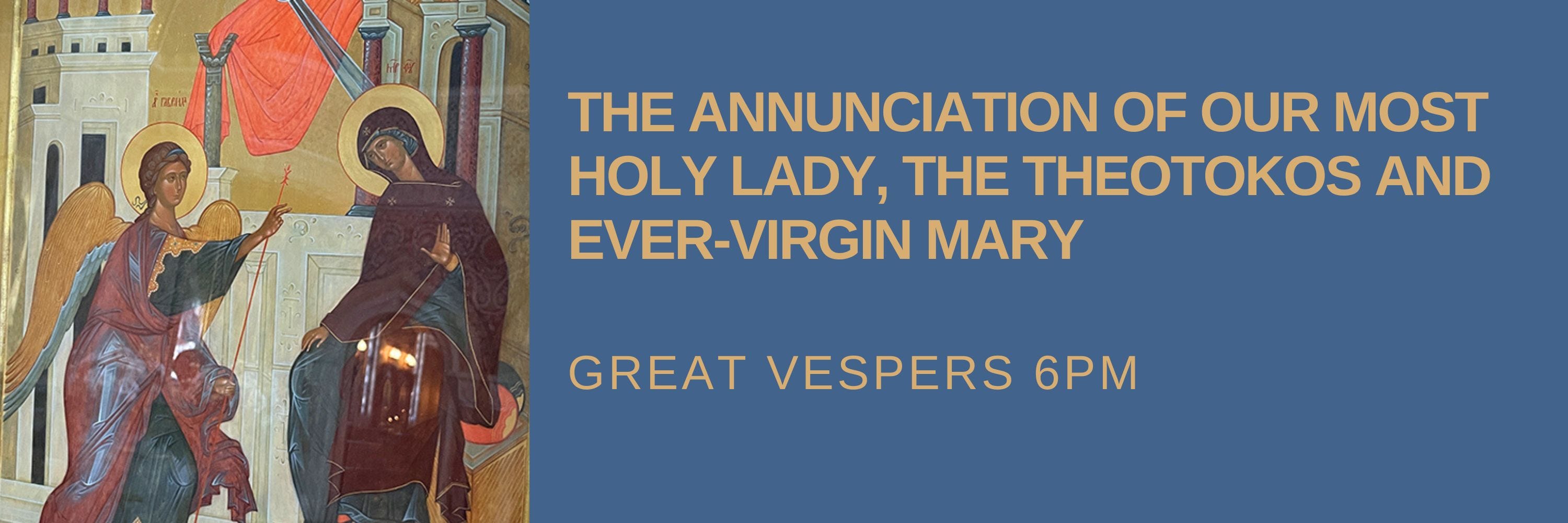
SUNDAY, MARCH 24th at 6pm
The Feast of the Annunciation is one of the earliest Christian feasts, and was already being celebrated in the fourth century. There is a painting of the Annunciation in the catacomb of Priscilla in Rome dating from the second century. The Council of Toledo in 656 mentions the Feast, and the Council in Trullo in 692 says that the Annunciation was celebrated during Great Lent.
The Greek and Slavonic names for the Feast may be translated as “good tidings.” This, of course, refers to the Incarnation of the Son of God and the salvation He brings. The background of the Annunciation is found in the Gospel of Saint Luke (1:26-38). The troparion describes this as the “beginning of our salvation, and the revelation of the eternal mystery,” for on this day the Son of God became the Son of Man.
There are two main components to the Annunciation: the message itself, and the response of the Virgin. The message fulfills God’s promise to send a Redeemer (Genesis 3:15): “I will put enmity between you and the woman, between your seed and her seed; he shall crush your head, and you shall lie in wait for his heel.” The Fathers of the Church understand “her seed” to refer to Christ. The prophets hinted at His coming, which they saw dimly, but the Archangel Gabriel now proclaims that the promise is about to be fulfilled.
We see this echoed in the Liturgy of Saint Basil, as well: “When man disobeyed Thee, the only true God who had created him, and was deceived by the guile of the serpent, becoming subject to death by his own transgressions, Thou, O God, in Thy righteous judgment, didst send him forth from Paradise into this world, returning him to the earth from which he was taken, yet providing for him the salvation of regeneration in Thy Christ Himself.”
The Archangel Gabriel was sent by God to Nazareth in Galilee. There he spoke to the undefiled Virgin who was betrothed to Saint Joseph: “Hail, thou who art highly favoured, the Lord is with thee: blessed art thou among women. And, behold, thou shalt conceive in thy womb, and bring forth a son, and shalt call his name Jesus. He shall be great, and shall be called the Son of the Most High: and the Lord God shall give unto him the throne of his father David: And he shall reign over the house of Jacob for ever; and of his kingdom there shall be no end.”
In contrast to Eve, who was readily deceived by the serpent, the Virgin did not immediately accept the Angel’s message. In her humility, she did not think she was deserving of such words, but was actually troubled by them. The fact that she asked for an explanation reveals her sobriety and prudence. She did not disbelieve the words of the angel, but could not understand how they would be fulfilled, for they spoke of something which was beyond nature.
Then said Mary unto the angel, “How shall this be, seeing I know not a man?” (Luke 1:34).
“And the angel answered and said unto her, ‘The Holy Ghost shall come upon thee, and the power of the Most High shall overshadow thee: therefore also that which shall be born of thee shall be called the Son of God. And, behold, thy cousin Elisabeth hath also conceived a son in her old age: and this is the sixth month with her, who was called barren. For with God nothing shall be impossible.’ And Mary said, ‘Behold the handmaid of the Lord; be it unto me according to thy word.’ And the angel departed from her.” (Luke 1: 35-38)
In his Sermon 23 on the day of the Annunciation, Saint Philaret of Moscow boldly stated that “the word of the creature brought the Creator down into the world.” He explains that salvation is not merely an act of God’s will, but also involves the Virgin’s free will. She could have refused, but she accepted God’s will and chose to cooperate without complaint or further questions.